You Cannot Evict a Movement: Report from Socialism Conference 2025
A grounded, firsthand account of how tenant organizers across the country are transforming isolation into community power

Watch the full conversation on the Haymarket Youtube channel.
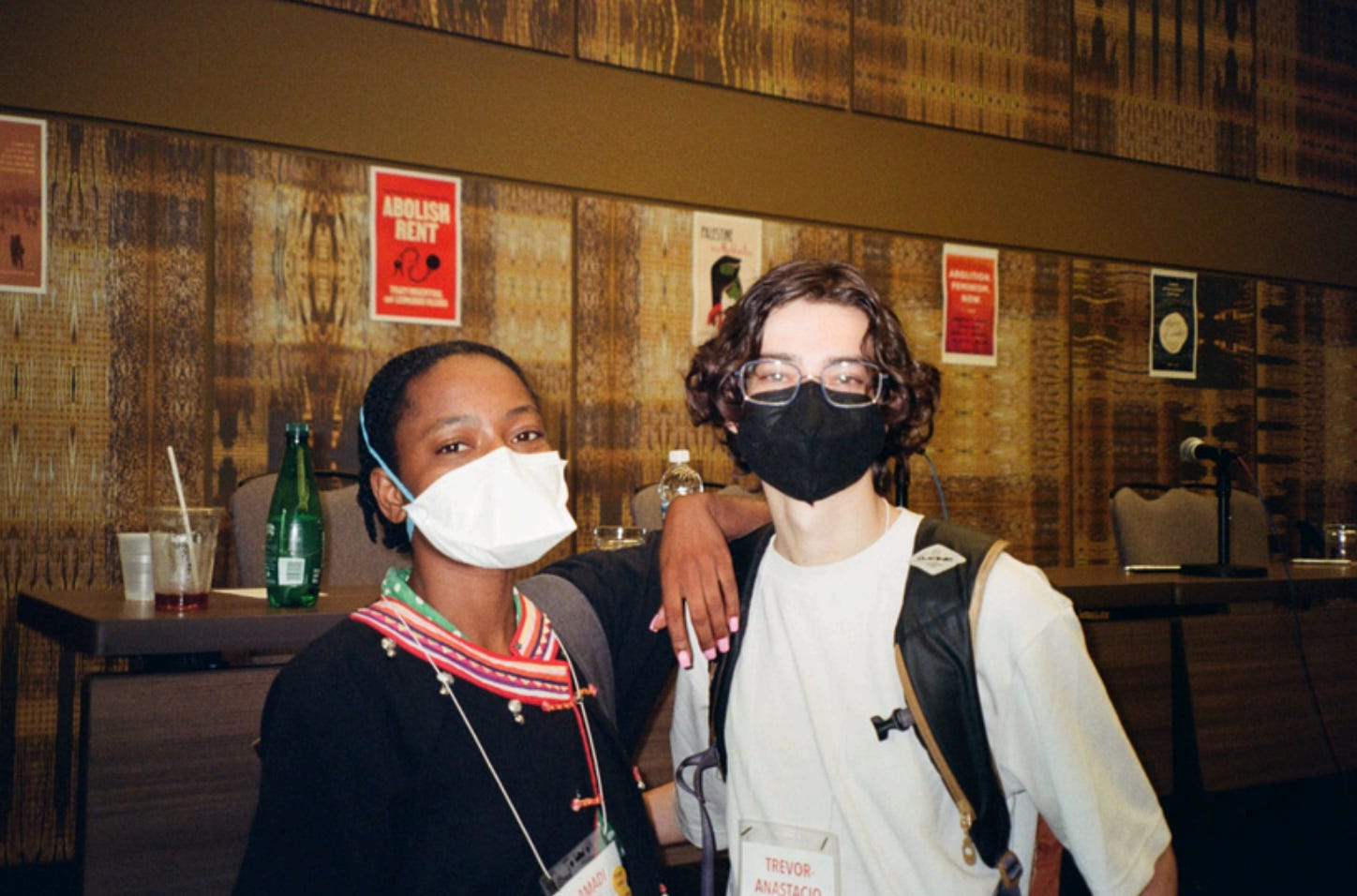
At this year’s Socialism Conference, Chicago, Fourth of July Weekend, tenant organizers from across the country gathered for “You Cannot Evict a Movement,” a session exploring how organized tenants work together to transform moments of crisis. Our conversation centered on “transitional demands” that move people beyond individual housing problems toward collective consciousness and lasting community relationships.
We opened the session with chants (“No landlords! No cops! All evictions got to stop!” and “Can’t pay! Won’t pay!”) and short stories from four organizers.
Khadija Haynes from Brooklyn Eviction Defense shared how dispossession shapes Black migrant tenants’ experience of power, and how naming those conditions can itself be a political act. “It’s not only the painful dehumanization people are forced to endure … it’s the perennial debasement of existing while poor and Black.” She described the heavy feeling of losing social ties when being forced out of one’s home. Khadija nearly died in a basement apartment after a landlord ignored a carbon monoxide leak. She passed out and spent the entire day in the hospital. The landlord’s first question was when she planned to pay rent.
Stephen Gurney of Brooklyn Eviction Defense described how his union uses guided discussion to link personal grievances to broader systems, helping tenants see themselves as part of a shared fight. For example, one building in Brooklyn won $92,000 in back rent after a fire in the basement, no heat, and other unlivable conditions. Tenant organizing allows us to forge new bonds and reimagine the existing social relations where we live. We show up for each other in court, so no one feels alone. We celebrate birthdays and new births, and we mourn deaths together. Before the tenant union, one tenant wanted to move out. Now, she wants to stay. She asked her neighbor for help making a prayer card. As Stephen said, “Economic conditions allow for communities to stay. Social relations allow for communities to grow.”
Amadi Ozier of Madison Tenant Power and Crown Heights Tenant Union talked about community storytelling as an eviction defense strategy. When we narrate local struggles we create a common memory that draws neighbors into action. “Making the impossible possible feels hard while you are doing it but feels so exhilarating when you win.” The goal is to pool the community’s existing energy and direct it toward one tenant’s struggle. A successful community defense sometimes requires hundreds of people to feel deeply invested. In Brooklyn, an elderly tenant in a $400 a month rent-stabilized apartment endured months of landlord harassment meant to push him out. Neighbors organized a rapid response. Tenant organizing is about “making the impossible feel possible” by defining clear roles: who talks to reporters, who brings food, who helps an elder with a computer, who keeps the schedule.
Trevor-Anastacio Ortega of Puget Sound Tenant Union talked about organizing across multiple scales where “people come before activist issues.” Trevor says, “Everybody’s down because we’ve all been part of the creation of this story.” The very idea of community can feel impossible. People have a hard time visualizing it until they experience it firsthand. Puget Sound Tenant Union shifted to weekly neighborhood meetings with food to ground organizing in relationships. Patterns began to emerge as people returned week after week. Tenants across buildings noticed their utility bills spiking from $50 to $300. When the union called a campaign around it, everyone was ready because everyone was living it. One building held out against a deal offering $100 per household. They want the entire billing system replaced. An even bigger demonstration is on the horizon.
We gave folks two discussion questions:
How have you felt isolated?
How have you built community?
After our storytelling, the audience broke into small groups to discuss atomization. By “atomization” I mean: our modern living conditions separate us from one another. In groups, we brainstormed ways to rebuild community: meals, childcare, street events, and parties for your building. Others explored tenant zines and listened to a housing-themed playlist.
We gave folks two discussion questions:
How have you felt isolated?
How have you built community?
The conversation concluded with a lively Q+A. Tenants from all over the country came to the microphone to share their tenant struggles. Neighbors discussed the ways tenant life can isolate neighbors. They shared strategies for building community through meaningful and consistent relationships.
The home we build together is the first step toward liberation. The goal isn’t just to win one case, but to politicize neighbors and make eviction defense contagious.
Further Reading
Arendt, Hannah. The Origins of Totalitarianism. New York: Harcourt, Brace, 1951.
Marx, Karl. Economic and Philosophic Manuscripts of 1844. Translated by Martin Milligan. Moscow: Progress Publishers, 1959.
Trotsky, Leon. The Death Agony of Capitalism and the Tasks of the Fourth International. New York: Pathfinder Press, 1977. Originally published 1938.